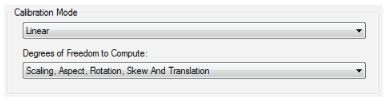
Select one of the following Calibration Mode values:
| Mode | Description |
|---|---|
| NoDistortionWarp | This mode will model perspective distortion only; any nonlinear optical distortion is ignored. By comparing the residual error values produced using this computation mode with the residual error values from ThreeParamRadialWarp or SineTanLawProjectionWarp you can improve your understanding of the individual sources of residual error. |
| ThreeParamRadialWarp |
This model calibrates for nonlinear optical distortion and perspective distortion. When compared with PerspectiveAndRadialWarp, this mode adds additional coefficients that properly model the location of the optical center. Note: This mode is recommended for lenses with minimal to moderate distortion, typically those with focal lengths greater than 6mm.
|
| SineTanLawProjectionWarp | This model calibrates for nonlinear optical distortion and perspective distortion. When compared with ThreeParamRadialWarp, this model uses a computation model that is appropriate for lenses with moderate to severe distortion, typically those with focal lengths less than 6mm. |
| Linescan2DWarp |
The calibration or fixturing computation will generate a nonlinear transformation between coordinate spaces suitable for use with a linescan camera. The transformation will calibrate for perspective and radial distortion. Note: This mode accommodates linescan configurations where the motion stage is tilted with respect to the direction of motion.
You may optionally specify the LinescanDistanceToTarget (in physical units) from the camera's image sensor plane to the surface of the calibration plate. If you supply this value, it should be accurate to within +/- 10%. Supplying this distance improves the robustness and accuracy of the computed calibration. |
| LinescanWarp |
The calibration or fixturing computation will generate a nonlinear transformation between coordinate spaces suitable for use with a linescan camera. The transformation will calibrate for perspective and radial distortion. Note: You may optionally specify the LinescanDistanceToTarget (in physical units) from the camera's image sensor plane to the surface of the calibration plate. If you supply this value, it should be accurate to within +/- 10%. Supplying this distance improves the robustness and accuracy of the computed calibration.
|
| PerspectiveAndRadialWarp |
This model calibrates for nonlinear optical distortion and perspective distortion. This method assumes that the optical center precisely corresponds to the image sensor center. Note: Cognex recommends using ThreeParamRadialWarp or SineTanLawProjectionWarp.
|
| Linear |
This model calibrates for linear distortion (aspect, skew, and shear) only. Note: If you select this mode, you can specify which DOFsToCompute to allow as the tool calculates the best-fit transformation between uncalibrated points and the raw calibrated points.
|
Select one of the following calibration Degrees of Freedom to Compute values.
| Option | Description |
|---|---|
| None | The transformation returned by the N point to N point fitting will be the identity transform. It will have unity scale and aspect. It will contain no rotation, skew, or translation. No points are required for this DOF computation. |
| TranslationX | The transformation computed by the N point to N point fitting will contain only translation in the X direction. At least one pair of points is required for this DOF computation. |
| TranslationY | The transformation computed by the N point to N point fitting will contain only translation in the Y direction. At least one pair of points is required for this DOF computation. |
| Translation | The transformation computed by the N point to N point fitting will contain only translation. At least one pair of points is required for this DOF computation. |
| RotationAndTranslation | The transformation computed by the N point to N point fitting will contain only rigid rotation and translation. At least two pairs of points are required for this DOF computation. |
| ScalingRotationAndTranslation | The transformation computed by the N point to N point fitting will contain uniform scaling, rigid rotation, and translation. At least two pairs of points are required for this DOF computation. |
| ScalingAspectRotationAndTranslation | The transformation computed by the N point to N point fitting will contain nonuniform scaling, rigid rotation, and translation. At least three pairs of points are required for this DOF computation. |
| ScalingAspectRotationSkewAndTranslation | The transformation computed by the N point to N point fitting will contain nonuniform scaling, skewed rotation, and translation. At least three pairs of points are required for this DOF computation. |