ScaleImage
Re-samples the pixels in an input image or region of interest (ROI) to produce a reduced, enlarged, unrotated, or unbent version of the image. The function displays the re-sampled image in the upper-left corner of the In-Sight Spreadsheet spreadsheet.
ScaleImage Inputs
| Parameter | Description | ||||||||||||
|
Image |
This parameter must use Cell References in
a spreadsheet cell that contains an Image data structure. By
default, this parameter references A0, the cell containing the Image data structure returned by function. This parameter can also reference other
Image data structures, such as those returned by the Vision
Tool Image Functions |
||||||||||||
|
Fixture |
Defines the Region of Interest (ROI) relative to a Fixture input or the output of the image coordinate system for the Vision Tools function. Setting the ROI relative to a Fixture ensures that if the Fixture is rotated or translated, the ROI is rotated or translated in relation to the Fixture. Note: 2D projections use real world units but fixturing with 2D tools requires input in pixel values. When using a 2D projection from a 3D point cloud as a Fixture, convert the real world units to pixel values using the TransWorldToPixel function.
The default setting is (0,0,0), the top leftmost corner of the image.
|
||||||||||||
|
Region |
Also known as the Region of Interest (ROI), specifies the region of the image that undergoes analysis. Double-click on the Region parameter to create an Interactive Graphics Mode that you can transform and rotate. Select this parameter and press the Maximize Region button on the Job Edit toolbar of the property sheet to automatically stretch the region to cover the entire image.
|
||||||||||||
| X Scale |
Specifies the percentage in the X direction of the region (10–1000; default = 50.) Note: Values between 100 and 1000 specify upsampling. For example, if both the ratios are specified as 200, the resampled image will be twice as large as the specified Region.
|
||||||||||||
| Y Scale |
Specifies the percentage in the Y direction of the region(10–1000; default = 50.) Note: Values between 100 and 1000 specify upsampling. For example, if both the ratios are specified as 200, the resampled image will be twice as large as the specified Region.
|
||||||||||||
|
Display X |
Specifies the x-coordinate (default = 0) where the rescaled image will be displayed, relative to the upper left-hand corner. Note:
Specifying a value of -1 will ensure that the function places the scaled image at the same x-coordinate as the input image:
|
||||||||||||
|
Display Y |
Specifies the y-coordinate (default = 0) where the rescaled image will be displayed, relative to the upper left-hand corner. |
||||||||||||
|
Show |
Specifies which graphical overlays are displayed on top of the image.
|
ScaleImage Outputs
|
Returns |
An Image data structure containing the processed image, or #ERR if any of the input parameters are invalid. |
ScaleImage Example
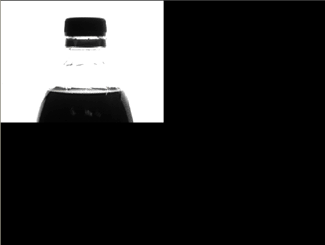
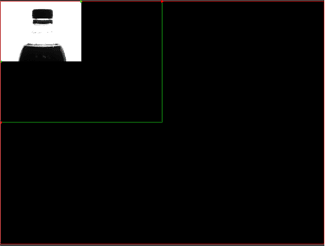
In this example, the object in the input image is a bottle. The purpose of this example is to scale the size of the bottle to 50%.
-
Insert the function into the In-Sight Spreadsheet spreadsheet.
-
Define the ROI by double-clicking on Region in the property sheet, which disappears to reveal the red ROI box overlaid on the image.
-
Move or resize the box using the cursor.
-
Click OK on the Job Edit toolbar to confirm the selection and return to the property sheet. (The selection can also be confirmed by pressing the Enter key or by double-clicking within the ROI.)
-
Type 50 in both the X Scale and Y Scale fields.
-
Accept the default settings of the other parameters and click OK in the property sheet to complete the configuration for this example and apply the function to the input image. The example shows a 50% scaled image of the bottle.
-
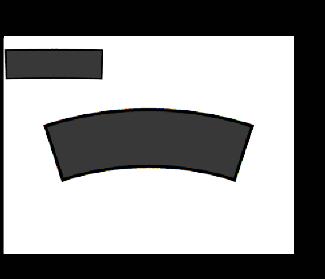
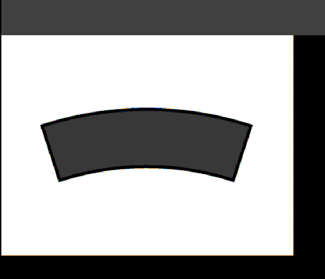
Use ScaleImage to "unbend" or "unrotate" objects, which can make it easier to reference other tools to the processed output image. In this example, the object is a slightly curved segment, which is shown with the Overlay removed (achieved by clicking Overlay on the View menu). The segment is also scaled to 50% in size, so that both the input image and output image can easily fit in the same view.
-
After inserting the function, define the ROI and specify 50 in both the X Scale and Y Scale fields in the property sheet (described earlier in the bottle example).
-
Incrementally change the values in the Angle and Curve fields under the Region parameter until the object is straight.
-
Accept the default settings of the other parameters and click OK in the property sheet to complete the configuration for this example and apply the function to the input image. The example shows an image of the bent object in the middle and the smaller and "unbent" version in the upper-left corner. In this example, an angle of 17.390 and a curve of -36.389 were needed to straighten the curved segment.