Hand-Eye Calibration
Hand-eye calibration establishes the spatial relationship between the vision system and the robot coordinate system. This calibration allows the vision system to transform vision results into robot-referenced poses that can be used for motion.
Hand-eye calibration is required for all VGR Vision-Guided Robotics is an In-Sight Spreadsheet feature that uses machine vision to guide robot motion through Robotics String Functions and VGR commands. applications that:
-
Use robot-driven alignment
-
Return target poses to the robot controller
You can configure hand-eye calibration using the VGRHandEyeCalibration function Functions are tools that are available in Spreadsheet for processing and analyzing acquisitions or other results. You can add functions to your Spreadsheet job to create tool chains and produce results for specific applications., and execute the calibration using robot-driven calibration commands.
Vision System Configuration Considerations
The hand-eye calibration procedure varies depending on whether the vision system is stationary or robot-mounted.
|
|
|
|---|---|
| Robot-Mounted Vision System | Stationary Vision System |
| The vision system moves together with the robot, while the calibration part remains stationary. The system performs hand-eye calibration by moving the robot through multiple positions and orientations, and capturing calibration data at each pose. Because the vision system moves relative to the fixed part, the detected fiducial appears to shift in the opposite direction in the image. | The vision system remains fixed while the robot moves the calibration part through multiple positions and orientations. The system performs hand-eye calibration by repositioning the part at different X, Y, and rotational offsets while capturing calibration data at each pose. Because the vision system does not move, the detected fiducial appears to shift in the same direction as the part in the image. |
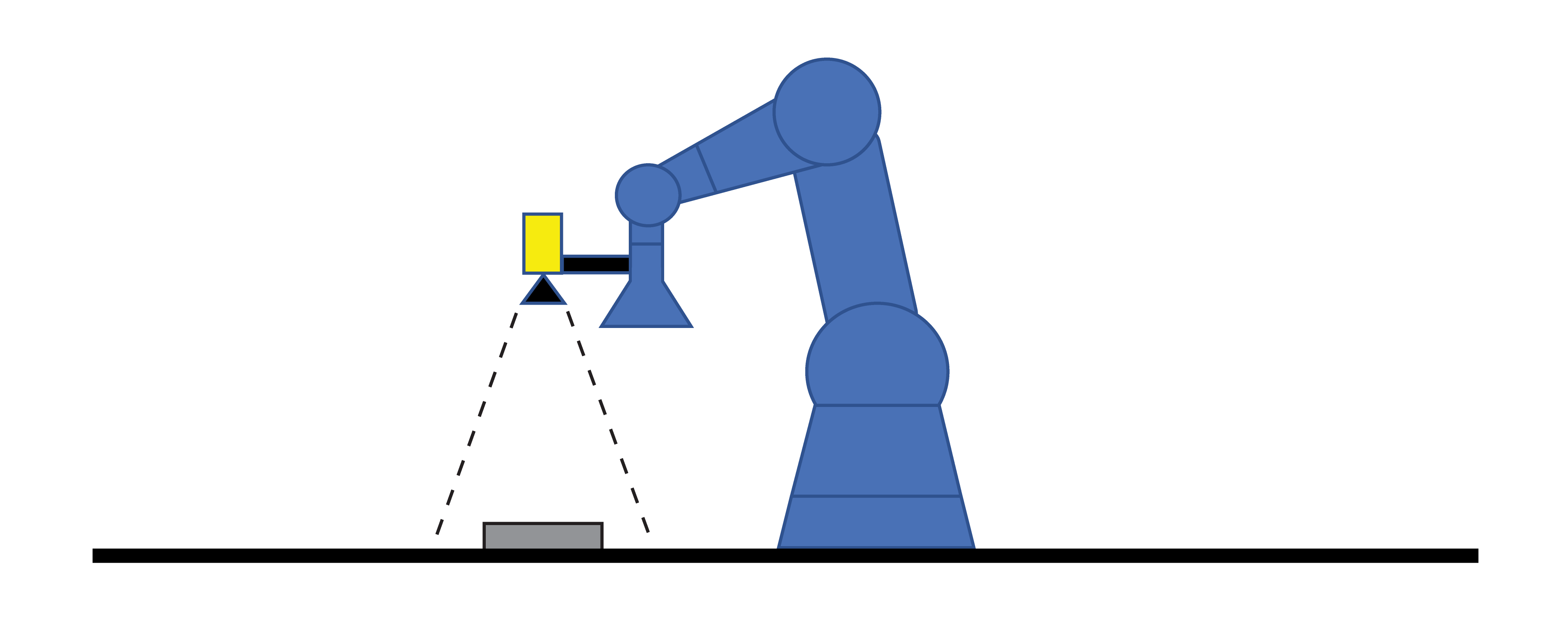
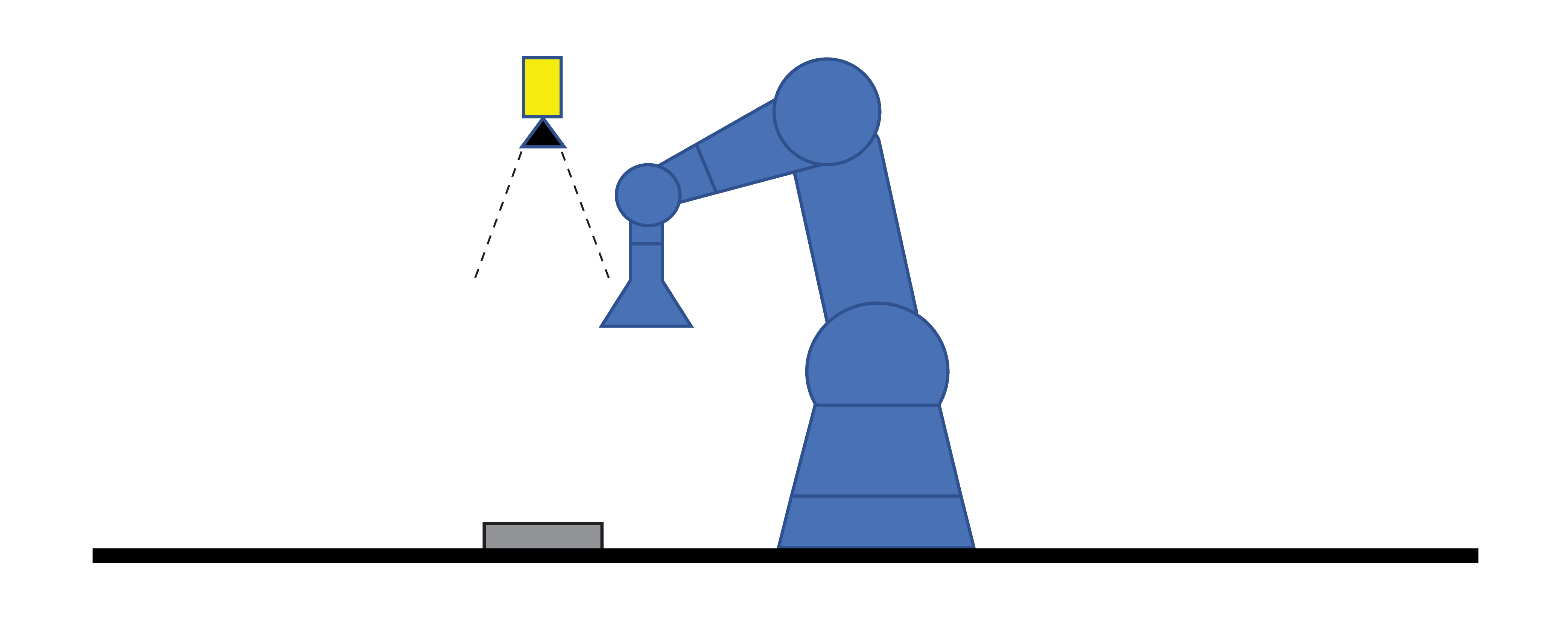
Calibration Pose Requirements and Distribution
Hand-eye calibration requires capturing data at multiple robot poses with sufficient variation in position and orientation to accurately establish the relationship between the vision system and the robot coordinate system.
To achieve good calibration accuracy, use calibration poses that are well distributed across the vision system field of view (FOV), as shown on the following image.
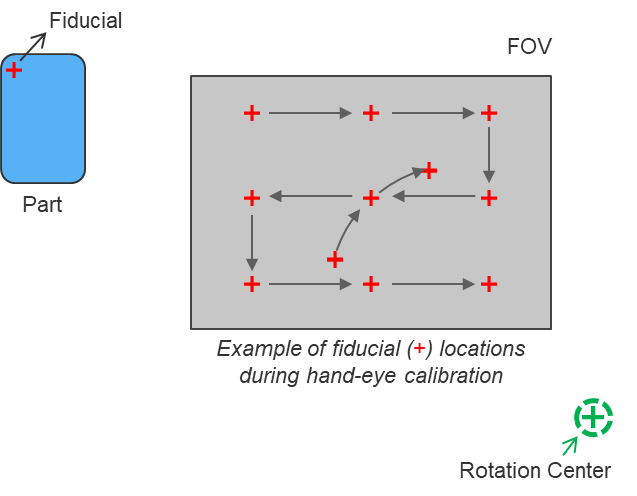
For good calibration accuracy, Cognex recommends using at least 11 calibration poses, consisting of:
-
9 translational poses (variation in X and Y)
-
2 rotational poses (rotation about the Z axis)
Using fewer than the minimum number of poses results in calibration failure. Including both positional and rotational variation improves calibration robustness and accuracy.