ISO/IEC 15416 (ANSI X3.182) Parameters
The ANSI parameters section lists each of the nine ANSI parameters and gives a summary of the measurements based on all scans taken. Each parameter is completely explained below. Note that some of these parameters are average values over all of the scans, and the averages may skew or alter the apparent results.
This section may be helpful in situations where the barcode cannot even be read. Therefore, the descriptions of each parameter below explains what is measured in the case where a code is read and not read. When a code is not read, the scan is analyzed for apparent quiet zones, and the bars and spaces in between are used for the ANSI analysis.
1. EDGE: Edge Determination
Edge Determination is a pass or fail parameter that is counting the number of edges in the code.
 Explanation
If at least one scan results in a decoded barcode, the EDGE value is the number of bars and spaces, not including quiet zones, in the code. If no scans result in a decoded barcode then the EDGE value shown is the number of bars and spaces found between quiet zones (or apparent quiet zones) on the scan on which the most bars and spaces were found. The Scan Reflectance Profile graph can also be very helpful in analyzing a code that cannot be decoded
2. Rl/RD: Minimum Reflectance
Graded as A or F, the reflectance value for at least one bar must be less than half the highest reflectance value for a space.
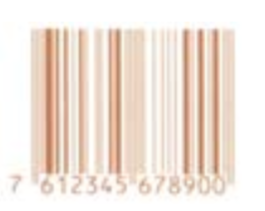
ExplanationMinimum Reflectance checks if the darkness of the bars is sufficient. The amount of light reflected by the bars (bar reflectance) needs to be less than half the light reflected by the spaces (space reflectance). The values shown are the light reflectance and the dark element reflectance separated by a slash. The light reflectance is the maximum reflectivity found in the scan (the lightest or best space), and the dark reflectivity is the minimum reflectivity found in the scan (the darkest or best bar). The requirement is for the minimum reflectivity to be no more than half the maximum reflectivity. If this requirement is met, the grade is A, otherwise it is F.
3. SC: Symbol Contrast
Symbol Contrast measures the contrast between the brightest space and darkest bar. The contrast is the difference between the maximum reflectivity (lightest or best space) and the minimum reflectivity (darkest or best bar).
| SC % | Grading |
|---|---|
| > 70 | A |
| 55-70 | B |
| 40-55 | C |
| 20-40 | D |
| < 20 | F |
4. MinEC: Minimum Edge Contrast
A pass or fail parameter checking the level of contrast between adjacent spaces and bars is at least 15%.
ExplanationMinimum Edge Contrast checks that the contrast between adjacent bars and spaces is high enough. When a barcode is scanned, the vision system needs to locate the edges between each bar and space. If the difference in the light and dark elements is not significant, this may not be achieved.
5. MOD: Modulation
The minimum edge contrast as a fraction of overall symbol contrast,that is, MinEC divided by SC.
ExplanationModulation checks the edge contrast as a fraction of the overall or best case contrast measured in symbol contrast. Modulation is an important measure of minimum edge contrast since most barcode reading devices employ “adaptive thresholding circuits” of some type that are sensitive to a symbol’s contrast in order to detect transitions between bars and spaces.
If all bars and spaces were the same brightness, the minimum edge contrast would be equivalent to symbol contrast. In this case, modulation would be 100 percent.
If some spaces are less bright than the brightest one, modulation is some fraction of the overall contrast. Modulation therefore measures the amount of available contrast that is manifested in the worst-case bar to space transition. Excessive ink spread or bar growth can result in low modulation because very narrow spaces appear to be filled in by the encroaching bars in the Scan Reflectance Profile.
| MOD % | Grade |
|---|---|
| >= 70 | A |
| >= 60 | B |
| >= 50 | C |
| >= 40 | D |
| < 30 | F |
6. Def: Defects
A graded value that refers to a spot in a space or a void in a bar. The formula for defect is element reflectance non uniformity max divided by symbol contrast.
ExplanationThe worst-case change in reflectance within a single bar or space is a defect. The largest difference in reflectivity found in a single bar or space is measured as a percentage of the symbol contrast and assigned a letter grade. This very serious issue for scanners was not directly addressed by traditional verification techniques. Defects normally measure breakups or voids within bars, ink spots in spaces, or even the grain of a substrate in spaces.

| DEF % | Grade |
|---|---|
| <= 15 | A |
| <= 20 | B |
| <= 25 | C |
| <= 30 | D |
| > 30 | F |
7. DCD: Decode
A pass or fail parameter looking to see if the code can be decoded using the standard reference decode algorithm with the selected aperture.
ExplanationThe widths of each bar and space are measured and used to interpret the data content of the barcode according to a specific mathematical formula appropriate for the barcode type. If the barcode cannot be decoded according to the formula, the accuracy of the bar and space widths are inadequate.
The printout shows the number of scans decoded over the number of scans taken, e.g. 8/10 means 8 out of 10 scans decoded.

8. DEC: Decodability
Decodability is a measure of how closely the element widths match their nominal sizes and are identified with margin-for -error by the reference decode algorithm.
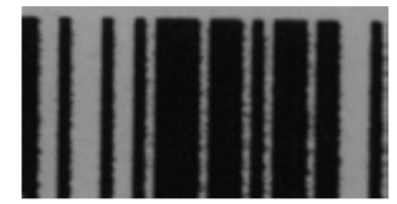
ExplanationDecodability determines how accurate the bar and space widths are and how easily the widths can be determined. A perfectly accurate barcode has 100 percent decodability, but decodability as low as 25 percent is often acceptable.
Decodability is always measured in terms of the formula used to interpret the bar and space widths into the data content of the barcode. In order to read barcodes, thresholds between element widths are normally established according to prescribed “decode algorithms”. Decodability is normally the percentage of the overall tolerance range for a bar or space width that is not used up by inaccuracies.
| DEC % | Grade |
|---|---|
| >= 62 | A |
| >= 50 | B |
| >= 37 | C |
| >= 25 | D |
| < 25 | F |
9. QZ: Quiet Zone
Checks that there is enough open space to the left and the right of the barcode.
ExplanationThis refers to a dedicated amount of blank space on the left and right of the barcode. Each symbology specifies a minimum quiet zone. For example, UPC-A barcodes should have at least a nine module quiet zone on each side, whereas an EAN-13 barcode permits legal quiet zones to be as small as seven modules.