Advanced Acquisition Settings
With Advanced Acquisition Settings, you can adjust the settings for the next image acquisition. To see advanced acquisition settings, click on the cogwheel button on the right side of the Setting Image pane. The Advanced Acquisition Settings are only available in Camera mode.
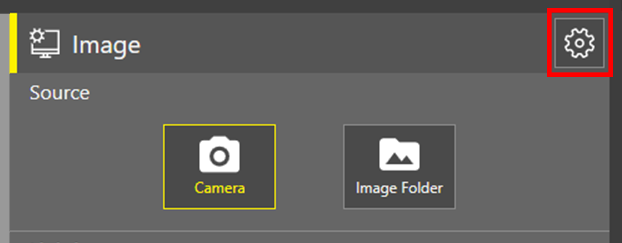
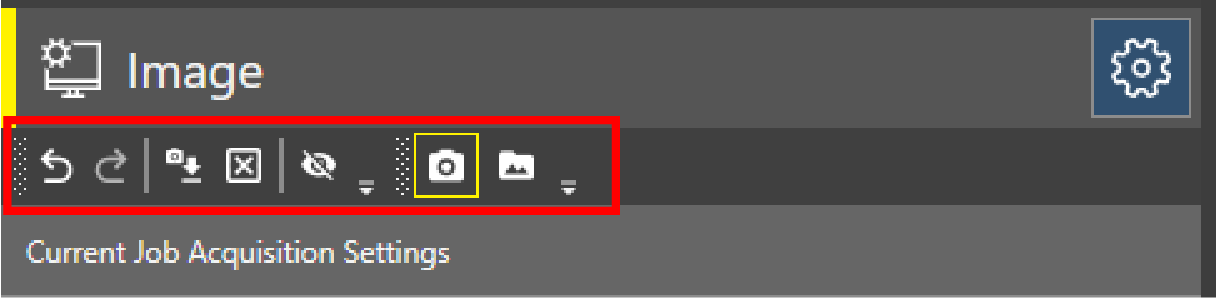
After Advanced Acquisition Settings mode becomes visible on the right side of the screen, you can find the action bar on the top of the Image pane.
|
|
|
|---|---|
| Icons | Action |
|
|
To undo last action, click Undo. |
|
|
To redo last action, click Redo. |
|
|
To reset the settings back to the property values in-use when first connected to the device, click Reset Settings. |
|
|
To reset acquisition settings to the default values, click Reset Acquisition. |
|
|
To toggle visibility of settings that currently have no effect, click Show/hide no effect settings. |
|
|
To set the source of images to the camera, click Camera Mode. |
|
|
To set the source of images to the image folder, click Image Folder Mode. |


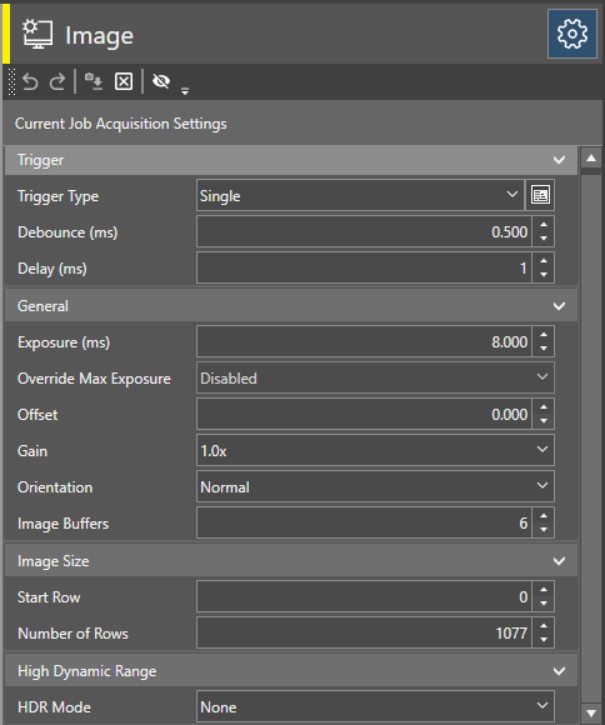
To further adjust the configurations for triggering, image formation, and calibration, use the tools under Current Job Acquisition Settings.
|
|
|||
|---|---|---|---|
| Section | Tool | Function | Values |
| Trigger | Trigger Type |
Defines the type of trigger signal that begins an image acquisition. |
Single |
| Self | |||
|
Trigger Interval (ms) (Appears in Self Trigger Type mode) |
Defines the time in milliseconds between acquisitions when using an interval trigger type. | [0,10000] | |
|
Debounce (ms) (Appears in Single Trigger Type mode) |
Defines the time in milliseconds that a camera trigger has to last to a trigger acquisition. | [0,10] | |
|
Delay (ms) (Appears in Single Trigger Type mode) |
Defines the delay between the time that the vision system receives a trigger to acquire an image, and the time the vision system begins the image acquisition. | [0,10000] | |
| General | Exposure (ms) |
Defines the exposure time. When the vision system receives an image acquisition trigger signal, light is integrated into the image sensor array for the specified duration. Note: The maximum exposure value varies based on the connected illumination capabilities.
|
[0,*] |
| Override Max Exposure |
If you enable this tool, you can set the exposure time value to a greater setting than recommended. This means that you extended the image exposure beyond the time the illumination is on. The default value is Disabled. |
Enabled | |
| Disabled | |||
| Offset |
Defines a direct current (DC) level that is added to the analog signal of the image sensor before the analog-to-digital conversion to brighten the image additively. |
[0,255] | |
| Gain | Defines the gain of the amplifier stage that precedes the analog-to-digital conversion. | [1x, 2x, 3x, 4x, 6x, 8x] | |
| Orientation |
Defines the orientation of the processed image. |
Normal | |
| Mirrored horizontally | |||
| Flipped vertically | |||
| Rotated 180 degrees | |||
| Image Buffers |
Defines the number of image buffers allocated for acquisition. Considerations for setting the image buffer:
Note: When in Single Trigger mode, if a trigger is received but no buffer is available for image acquisition, the image acquisition does not occur. In addition, if a Discrete Output line is configured to use ERR: Missed Acquisition, this signal is raised for each acquisition until a buffer becomes available.
|
[6,25] | |
| Autoexposure |
A single button to auto-set the exposure based on current light settings. |
||
| Image Size | Start Row | Defines the first row to transfer from the image sensor into the memory of the vision system. |
[0, Maximum Resolution - 4 ] Note: For IS2800, ADV182, and IS3800 models, values must be divisible by 4.
|
| Number of Rows | Defines the number of image sensor rows to transfer into the memory of the vision system. |
[4, Maximum Resolution] Note: For IS2800, ADV182, and IS3800 models, values must be divisible by 4.
|
|
| High Dynamic Range | HDR Mode | Enables or disables High Dynamic Range (HDR) processing. |
[None, HDR, HDR+] Note: HDR+ is only available on IS3800 models.
|
| Illumination | Mode | Defines the illumination devices. | Integrated illumination |
| Disabled | |||
| Intensity | Specifies the intensity of the illumination LED banks as a percentage. | [0,100] | |
| Always On | If you enable this tool, the LEDs continuously illuminate. The default value is Disabled. | Enabled | |
| Disabled | |||
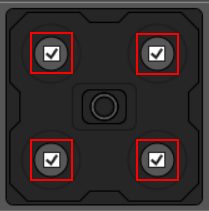
| Banks Enabled |
Check or uncheck the checkboxes inside the banks on the graphic to enable or disable each bank. Note: Banks graphics can vary depending on the illumination hardware attached to the vision system.
|
|
|
| Light color |
Defines the illumination color. Note: Light color tool appears only if a Mini Torch is connected to the vision system.
|
WHITE | |
| RED | |||
| GREEN | |||
| BLUE | |||
| Strobe Start | Defines when the strobe starts. The default setting is Acquisition Start. | Acquisition Start | |
| Camera Trigger | |||
| Strobe Polarity | Defines the signal that fires a connected strobe. The default setting is Low. | Low | |
| High | |||
| Focus Note: Focus options appear only when a liquid lens is attached to the vision system. |
Focus Distance (mm) | Focus distance in millimeters. | [65,4043] |
| Autofocus | A single button to auto-set the focus position based on current settings. | ||
To return to Source and Lighting settings view, click the cogwheel button in the right top corner of the Image pane.