Store File
Saves the current job
in the flash memory on the In-Sight vision system
-
If you check the Allow Online Job Save checkbox, users with Full or Protected access have permission to save jobs while Online. If you uncheck the Allow Online Job Save checkbox, the vision system must be Offline to save jobs.
- To save the current job file to the RAMDisk folder of the In-Sight vision system with the specified filename, the syntax is: TFRAMDisk/[Filename]. For example, to save the file Test.jobx to the RAMDisk folder of the vision system, issue the following command: TFRAMDisk/Test.jobx.
- To save the current job file to the SD card folder of the vision system with the specified filename, the syntax is TFSDCARD/[Filename]. For example, to save the file Test.jobx stored to the SD card folder of the vision system, perform the following command: TFSDCARD/Test.jobx.
- The Job Server Settings dialog is used to configure an FTP server that will host In-Sight job files for the vision system, which allows another device, such as a PLC or robot controller through the LF and TF Native Mode commands, to change jobs without specifying a location.
Store File Inputs
Syntax: TF<Filename>
|
Parameter |
Description |
|---|---|
|
Filename |
The name of the job. The command executes with or without the .JOBX extension. |
Store File Outputs
Returns a status code, followed by a line terminator. The status codes are:
| Status Codes | Description |
|---|---|
| 1 |
The command executes successfully. |
| 0 |
Unrecognized command. |
| -1 |
The filename is missing. |
| -2 |
The job fails to save, the vision system is Online or the file is not found, therefore the command can not execute. |
| -6 |
User does not have Full Access to execute the command. |
Store File Example
To name the current job Test and save it in flash memory on the In-Sight vision system, issue the following command:
TFTest.jobx
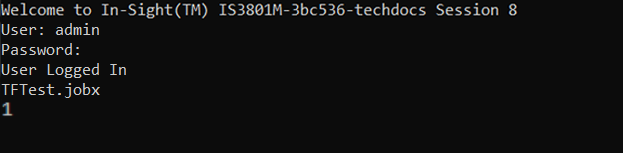
The In-Sight vision system responds with 1, indicating that the save operation of the current job is successful.