Set Region3D
The Set Region3D command sets values on a Region3D structure and works only with a cell with an EditRegion3D function.
Set Region3D Inputs
Syntax: ST<cellName> <sizeX> <sizeY> <sizeZ> <curve> <posX> <posY> <posZ> <rotation> <tilt> <tiltDirection>
| Parameter | Description |
|---|---|
| cellName | The name of the Region3D. |
| sizeX | Size parameters of the Region3D. |
| sizeY | |
| sizeZ | |
| curve | The curvature parameter of the Region3D. |
| posX | Position parameters of the Region3D. |
| posY | |
| posZ | |
| rotation | Orientation parameters of the Region3D. |
| tilt | |
| tiltDirection |
Set Region3D Outputs
Returns a status code. The status codes are:
| Status Codes | Description |
|---|---|
| 1 |
The command was executed successfully. |
| 0 |
Unrecognized command. |
| -1 |
The ID is invalid. |
| -2 |
The command could not be executed because the specified cell does not contain an edit region control, or the edit region control was not created by the EditRegion3D function. |
| -4 |
Wrong argument type. |
| -6 |
User does not have Full Access to execute the command. |
Set Region3D Example
Set an edit region contained in cell A3 to a new location and dimensions.
-
Assume cell A3 is populated as follows: A3 = EditRegion3D($A$0,0,0,0,0,0,0,0,1,1,1,"region",0)
The spreadsheet looks like this:

-
To change the location and dimensions of the region using the Set Region3D Native Mode command, issue the command STregion 50 50 20 5 10 10 10 20 40 10 as shown in the following telnet client window. The string region stands for the cell name:
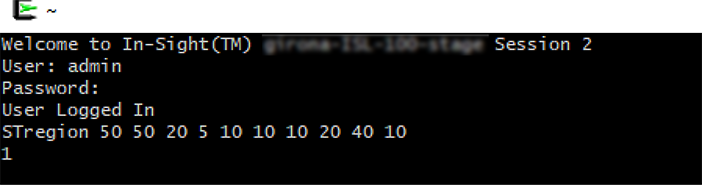
The In-Sight vision system responds with 1, indicating that the command was successfully executed:
