Differences between ISO/IEC 15415 and ISO/IEC 29158 grading standards
There are two verification standards from the International Organization for Standardization (ISO) that govern two-dimensional (2D) and direct part mark (DPM) codes.
- 2D codes printed on a label use ISO/IEC 15415.
- 2D DPM codes use ISO/IEC TR 29158, also known as AIM DPM.
ISO/IEC 29158, the standard for DPM codes, is a modification to the ISO/IEC 15415 standard to accommodate the variety of substrates and marking types for DPM codes.
The differences between ISO/IEC 15415 and ISO/IEC 29158 are the following:
Aperture
Aperture refers to the circular sample that is captured at grid intersections. Each of those sample circles are what the software will use to determine whether a cell is dark or light. Too big or too little aperture will cause your grade to be less accurate.
- In ISO/IEC 15415: you can select your own aperture size. It is typically recommended that the aperture size is 80% of the module size.
-
In ISO/IEC TR 29158 (AIM DPM): the software varies the size of the aperture until the symbol is decoded, and then repeats the grading with two different aperture sizes (50% and 80%). The better of the two grades is reported as the final grade.
When the reference decode algorithm fails to decode a symbol with both 50% and 80% aperture, the DECODE grade will be “F” and a note will be printed on the grade section of the report, even if the symbol is recognized and decoded with a different aperture size in an earlier phase of the grading procedure.
Global Threshold
The global threshold is essentially the point on a scale from dark to light that determines if a cell is closer to light or closer to dark.
-
In ISO/IEC 15415: the global threshold is a simple calculation of the median between the highest and lowest reflectivity values. The highest brightness (Rmax or RL) and the lowest brightness (Rmin or RD) are identified and then the global threshold is just the midpoint between these two extreme values.
-
In ISO/IEC TR 29158 (AIM DPM): there are often some spots of glare which causes Rmax to be very different from most of the other spaces in the code. This is a problem because it makes the global threshold higher, and then some of the other spaces are close to that threshold which makes them get a low modulation value.
In the ISO/IEC 29158 standard for DPM codes, a more optimal threshold is calculated using an algorithm commonly known as “Otsu’s Algorithm.” At a high level, this algorithm computes the minimum of the variances between dark and light elements. This is a more ideal global threshold that will result in higher values of modulation. This is the most important reason why ISO /IEC TR 29158 gives higher grades than ISO 15415, especially on DPM codes.
Lighting Options
- In ISO/IEC 15415: the default is four-sided 45˚ light.
-
In ISO/IEC TR 29158 (AIM DPM): allows additional lighting angles to make illuminating challenging DPM codes possible: 30˚ lighting from four sides, 30˚ from two sides (which can be either north/south or east/west), and 90˚diffuse on-axis lighting. The light source that is used is reported using a notation that includes the angle, and a letter (Q for 4, T for 2, and S for 1).
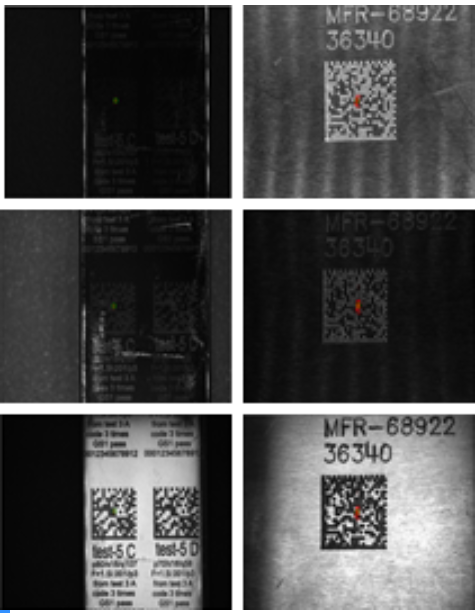
Image Sensor
The image sensor works the same for ISO/IEC 15415 as with ISO/IEC TR 29158. However, in 29158, the exposure is adjusted automatically to brighten the image so that a darker code will look brighter and the full range of grayscale is used in the sensor. For both 15415 and 29158 the illumination intensity is very high so that ambient light has no practical contribution to the image. However, the exposure value is changed in 29158 compared to 15415.
Calibration
Calibration is the process of mapping a camera’s measurement to actual reflectance levels.
The process is done to find an exposure time that is needed to give a full brightness image on the calibration card. A calibration card has barcode symbols that are measured against a National Institute of Standards and Technology (NIST) traceable judge card to determine the exact Symbol Contrast Rmin/Rmax values. These values are entered into the verification software at the beginning of the process so that the software can adjust the camera accordingly.
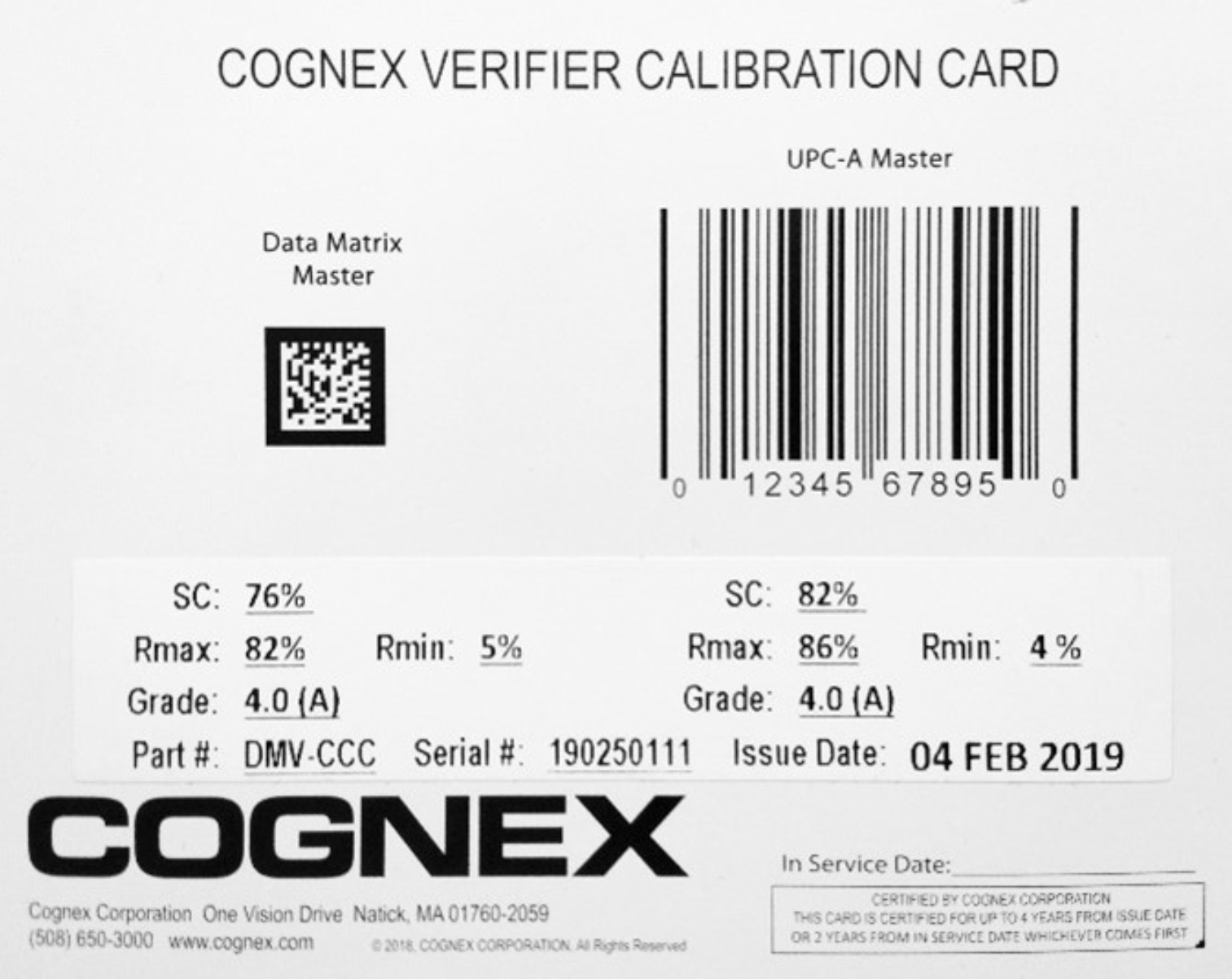
Currently, there are no DPM-specific calibration cards to challenge ISO/IEC 29158. A Data Matrix conformance test card can be used, but the contrast values will never perfectly match the value on the card because of the image adjustment used in 29158. Testing with the 29158 grading standard can be done to check for correct operation but will yield results that are different than those shown on the conformance card. It is recommended that the verifier also be tested using ISO/IEC 15415.
You can learn more about the differences of ISO/IEC 15415 and ISO/IEC 29158 grading standars here.