Multi-Port Connections
You can connect multiple DataMan 150 readers to a single PC (or other device equipped with a serial port) using a multi-port connection.
A multi-port connection creates a daisy-chain of readers. Each reader receives serial data from the previous reader and transmits it to the next reader. When a reader transmits data, it is passed through each of the readers in the chain between it and the PC.
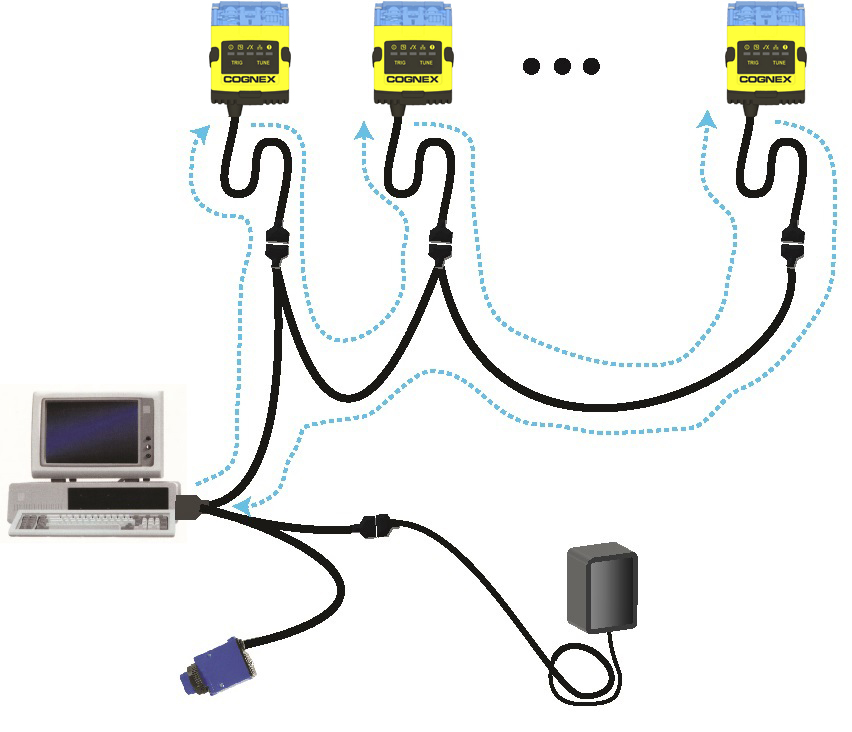
You must construct your own cable that meets the requirements of your system configuration.
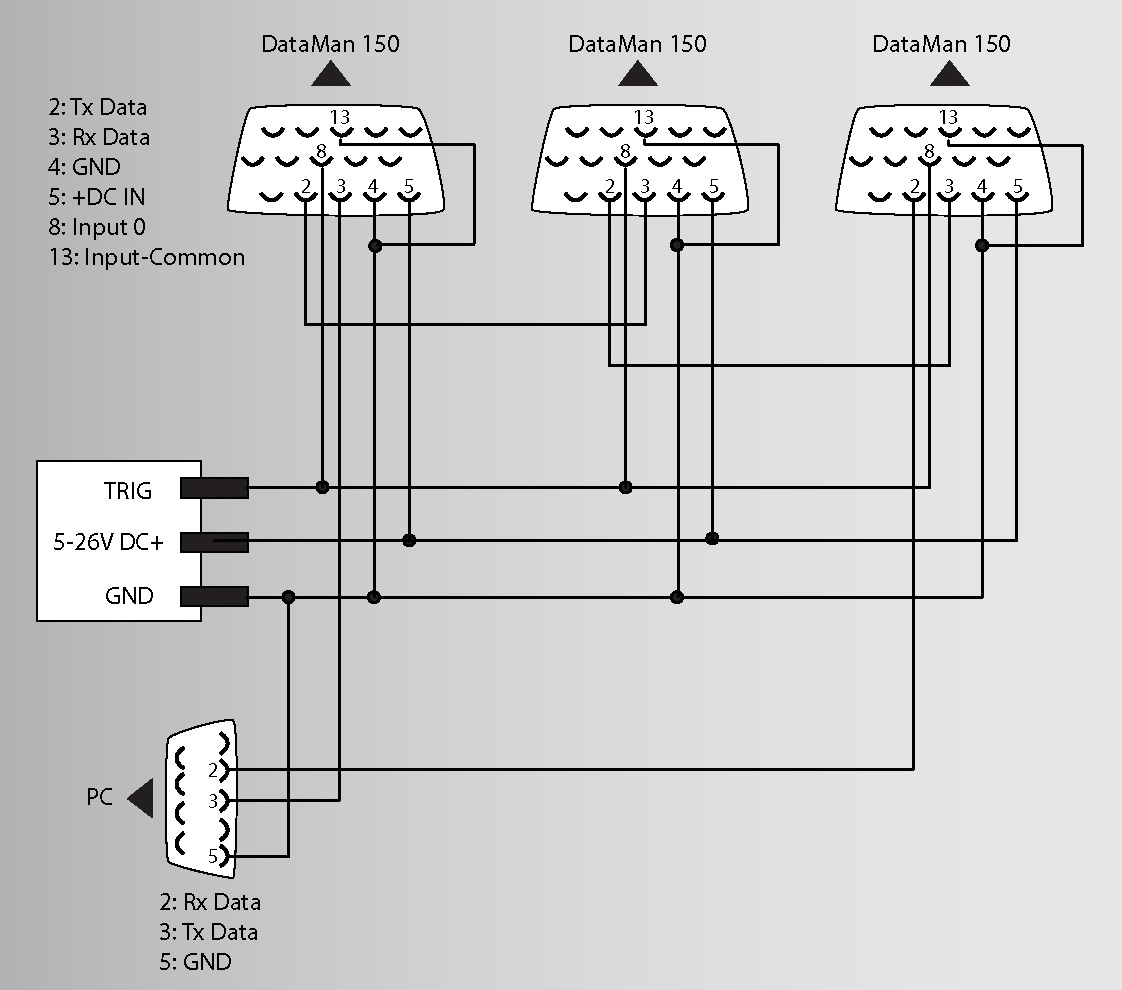
The cable must provide a DB-15 connector for each DataMan 150 and a DB-9 connector for the PC serial port. Each DB-15 connector must provide Tx Data, Rx Data, Trigger (Input 0), ground, and DC power. The Tx Data and Rx Data pins on adjacent connectors must be connected to provide the multi-port connection.
The following diagram shows how to create a multi-port cable for a 3-reader system. In the example, all the readers share a common trigger. It is also possible to wire individual triggers for each reader.
You must connect each DataMan 150 to DataMan Setup Tool using a USB connection and set the DataMan for multi-port operation. To configure a DataMan 150 for multi-port operation, click on the Enable Multi-Port (RS-232 Sharing) check box in Communication Settings.
There is no guaranteed delivery order when multiple readers transmit data using a multi-port connection; read results may arrive at the PC in any order. You can configure each DataMan 150 reader in a multi-port connection to add identifying data to each read result. Your PC application can then determine which reader produced a specific read result.
To do this, check the Standard Formatting Enabled box (for each symbology that you are using) in Data Formatting, and enter text in the Leading Text field. (You can also add trailing text by entering text in the Trailing Text field.)
You can obtain the best results when using multi-port connections by keeping the following usage guidelines in mind as you design your system:
- The maximum cable length between any two DataMan 150 readers or between the PC and any DataMan reader should be no greater than 15 meters.
- There is no fixed limit to the number of DataMan 150 readers that you can connect to a single PC. Each reader introduces a delay of about 100 ms when it retransmits received serial data. If you have 5 readers, this means that there will be a 400 ms delay between the time the first reader in the chain transmits data and the PC receives it.
- Each DataMan 150 reader must receive a hardware trigger signal on its Input 0 line. You can wire the input ports to a common trigger signal or you can provide individual triggers for each reader.
- Each DataMan 150 reader must be individually configured for multi-port operation, and you must perform this configuration using a USB connection.
- If any reader in the multi-port chain loses power or becomes disconnected, then no data from any other reader will be transmitted.
- If a DataMan 150 is transmitting its own read result, it will buffer any data received from another reader until it has finished its own data transmission. If a DataMan 150 is transmitting another reader’s data, it will buffer its own data if it receives a trigger signal while it is processing the other reader’s data.
- If you use a single power supply for multiple readers, make sure that the power supply can provide enough power for all of the readers.