Training and Deployment Phases
The operation of VisionPro Deep Learning has two main phases:
-
Training phase
-
Deployment phase
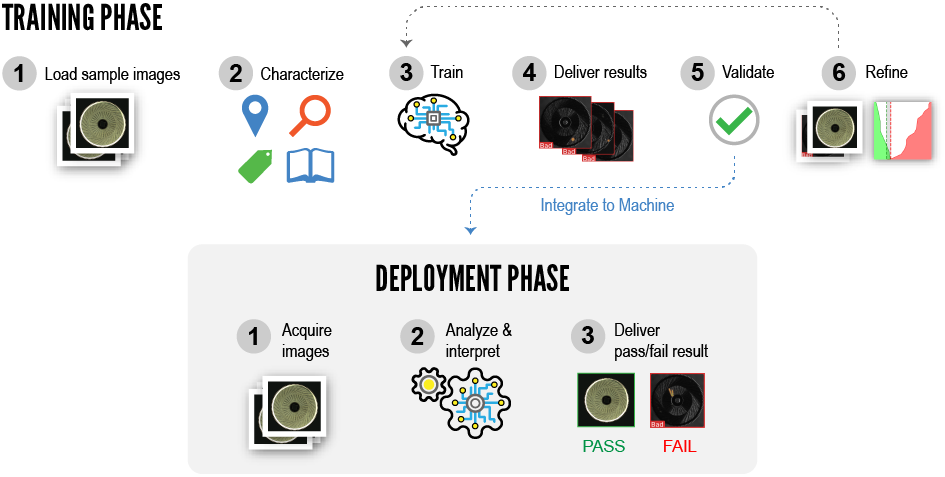
Training Phase
In the training Training is the process that your tool, which is a neural network, is learning about the features (pixels) based on the labels you made. For example, a tool will learn the defect/normal pixels in each image based on the defect/normal labels you drew. The goal of the tool Training is learning enough to give the correct inspection results of whether an unseen image is defective or not. The key to training is to ensure that you include all possible variations within your training set, and that your images are accurately labeled. Training times vary by the application, tool setup and the GPU in the PC being used to train the network. phase, you prepare VisionPro Deep Learning tools to solve a machine vision problem. You can train tools in the GUI and with the C++ or C# API as well. The quality of your training data determines the effectiveness of training, which then determines the runtime performance of the tools.
The training phase involves the following steps:
-
Collecting images
-
Labeling
-
Setting tool parameters
-
Neural network training
- Neural network processing
-
Reviewing markings
-
Evaluating results
Deployment Phase
In the deployment phase, you deploy the trained tools on your production line. You can deploy using the runtime workspace A runtime workspace is a configuration file that does not contain images or databases, containing only streams and tools, which makes it a smaller version of a full Workspace. This configuration file can be loaded in the library in order to perform some analysis. or the runtime API. In the deployment phase, the tools can process images, but you cannot modify or retrain the tools.
The deployment phase involves the following steps:
- Sampling
- Neural network processing
- Forming results