HSI Color Space
When human beings describe colors, they often do so in terms of the color’s hue (is it red, yellow, or violet), saturation (is it a pure color or is it diluted with white), and intensity (is it bright or dim). The HSI color space is based on the fact that all perceivable colors can be described in terms of these three measures.
- The hue of a color corresponds to its location within the visible portion of the electromagnetic spectrum of radiation:
- The saturation of a color is the degree to which the color is mixed with grey or white. A fully saturated color is pure. As a color becomes mixed with white (or grey) it becomes less saturated. For example, as the color red becomes less saturated (more mixed with white), it tends toward pink. The red of a fire engine is a saturated red, while the pink of a carnation is an unsaturated red. The figure below shows a range of saturation values for a single hue.
- The intensity of a color is a measure of its brightness. The intensity of a color is defined as the average value of the red, green, and blue components that make up the color.
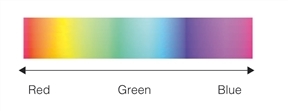
Hue
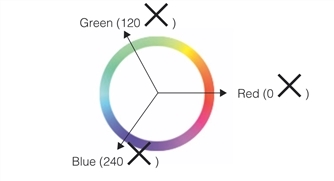
The conversion of a hue to a numerical value is done by creating a color wheel. A color wheel places all of the hues from the spectrum on a circle. A particular hue is specified by giving the angle at which that hue lies on the color wheel. The figure below shows a color wheel.
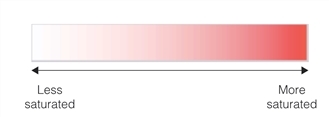
A color’s saturation is expressed as a number from 0 through 255 that indicates the amount of dilution by white. A value of 0 for saturation indicates grey.
The three components that make up the HSI color encoding can be visualized together as making up a space composed of two cones, as shown in the figure below.
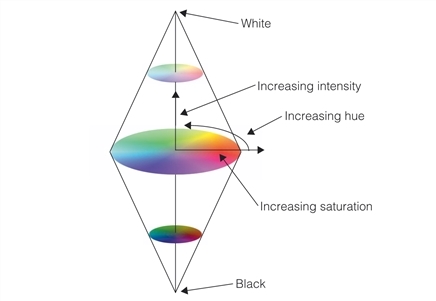
All possible colors occupy points within this volume. Completely saturated colors exist on the outside surface of the space. Shades of grey are located along the central axis of the shape; black is at the bottom vertex and white is at the top vertex.