Applications without a Representative Image
Conventional PatMax works by training a pattern based on the features found in a representative (or “good”) image of your part. In some applications, it may be impossible to acquire a part image that is not affected by noise, clutter, occlusion, or other defects.
Attempting to train a conventional PatMax pattern from such a degraded image often produces an unusable pattern, since the pattern includes numerous features that are not present in other run-time part images, as shown in the figure below.
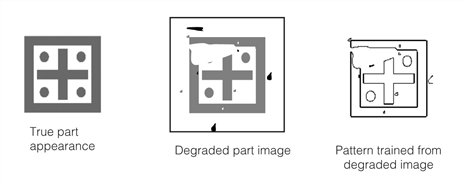
Pattern trained from unrepresentative image
You can train a nearly ideal Composite Model using multiple degraded training images. Composite Model PatMax collects the common features from each image and unites them into a single ideal model. This way, you can filter out noise or other random errors from the training images that would appear in the final Composite Model, as shown in the figure below.
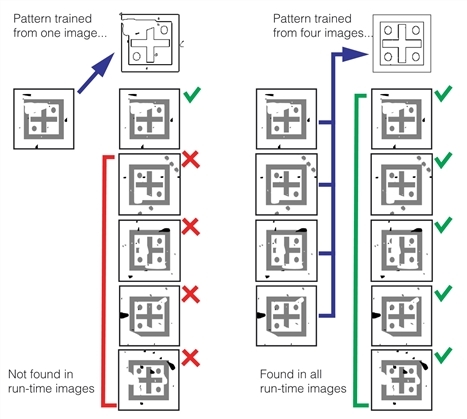
Composite model training from multiple degraded images
As shown in the figure above, the composite-trained pattern successfully finds the part in both the degraded images used for training, and in newly encountered images.