Barcode Tool Overview
A barcode is an array of vertical parallel lines and spaces (both called bars) used to represent data. The Barcode tool decodes barcodes of the following types: Bc39 (Code 39), Code128, BC412, IBM412.
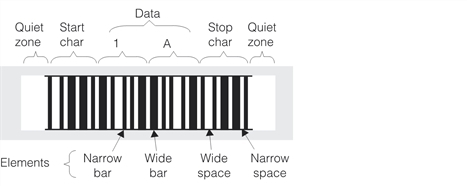
Bc39 barcode symbol structure shows a Bc39 barcode and identifies its parts.
The Barcode tool works by analyzing a series of vectors or scan lines that cross the image containing the barcode perpendicular to the barcode, as shown in Scan lines crossing a barcode.
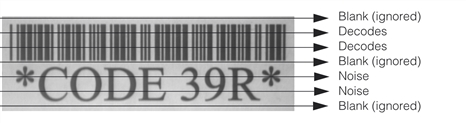
Along each scan line, the tool looks for patterns of dark-to-light and light-to-dark transitions. If a pattern meets certain criteria, the tool attempts to decode the bars represented by the pattern. After the tool has analyzed all scan lines, decoding those that fit the barcode pattern, it passes the decoding operation if the percent of correctly decoded lines exceeds an acceptance threshold, which you specify. The tool also calculates the checksum if it is enabled for the symbology. If the checksum is valid and the decoding operation has passed, the tool returns the raw and decoded strings, a score, the decode direction, and the amount of time required by the decoding operation.