One Time Calibration
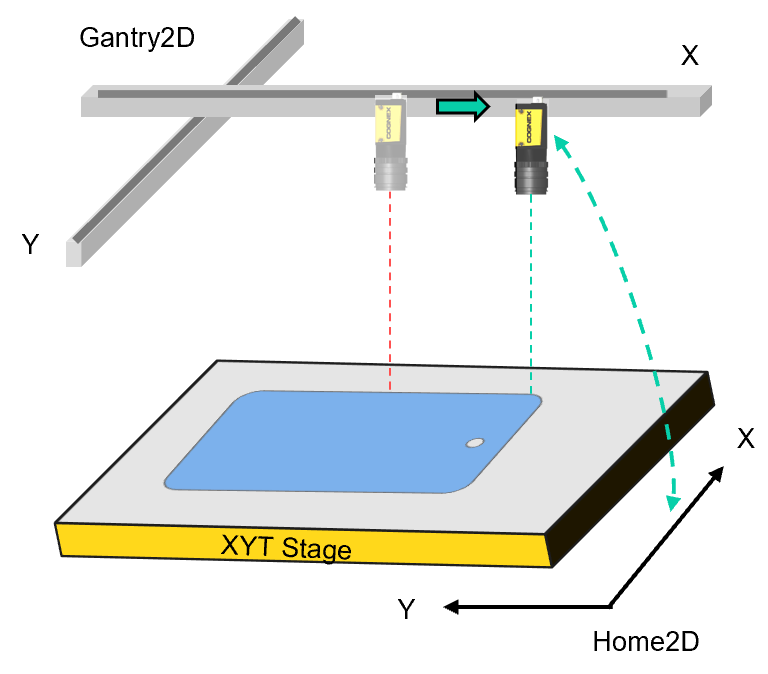
During model change, cameras may need to be repositioned to fit different part sizes. However, when a camera's position is changed, the vision system needs to recalibrate this camera to find its new position in Home2D. This recalibration (such as hand-eye calibration, cross calibration) process could take 15 minutes to 2 hours for a well-trained operator, which is too time-consuming when mode change on assembly lines are frequent. To reduce the time and efforts required in model change, AlignPlus provides one time calibration function to quickly recalculate cameras' new positions without recalibration.
One time calibration establishes the spacial relationship between the gantry where cameras are amount to and the moving stage or stationary platform where run time parts rest on. During model change, operators only need to input cameras' new positions in gantry's space (which can be easily read from the machine), then the vision system will map them into positions in Home2D using the relationship established by one time calibration.
One Time Calibration Process
During calibration time to first set up the machine, one time calibration establishes the relationship between the gantry's space and Home2D by running a single-camera moving hand-eye calibration for each camera, wherein the camera is moved by the gantry over a checkerboard plate to a serial of different points specified by the Looping Parameters. In the graphic below, the gantry moves along a 3x3 grid.
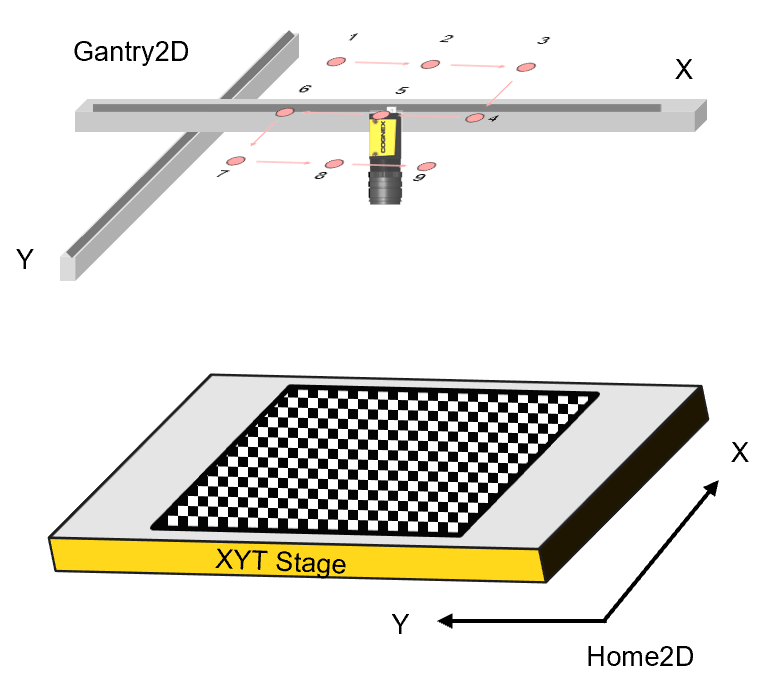
The steps to run an one time calibration for one camera is as blow:
-
Place the checkerboard plate on the stage/platform and keep the it stationary
-
Move the camera to the gantry's first point (or next point if it is not the first)
-
Send a calibration command to trigger the vision system to acquire one image of the checkerboard plate at current camera position
-
Repeat Step2 and Setp3 until all points are covered
-
Wait the one time calibration finish calculation and check the calibration result.
One time calibration is for one camera at a time. If there are multiple cameras used for alignment/assembly, each camera needs to run an one time calibration separately.
If camera shuttling is used for alignment/assembly, there is no need to run one time calibration for a camera at different acquisition positions since one position is enough to find the relationship between gantry's space and Home2D.
Mode Change
During mode change, after cameras are repositioned, operators can read their new positions in Gantry's space in the machine, and input them into the vision system. With the transform established between Gantry's space and Home2D during the calibration time, the vision system then can transfer cameras' Gantry2D coordinates into Home2D coordinates and apply the changes to its alignment/assembly calibration results (such as hand-eye calibration or cross calibration results). So that recalibration can be exempted.