Checkerboard-based Cross Calibration
This mode uses a checkerboard as the calibration target.
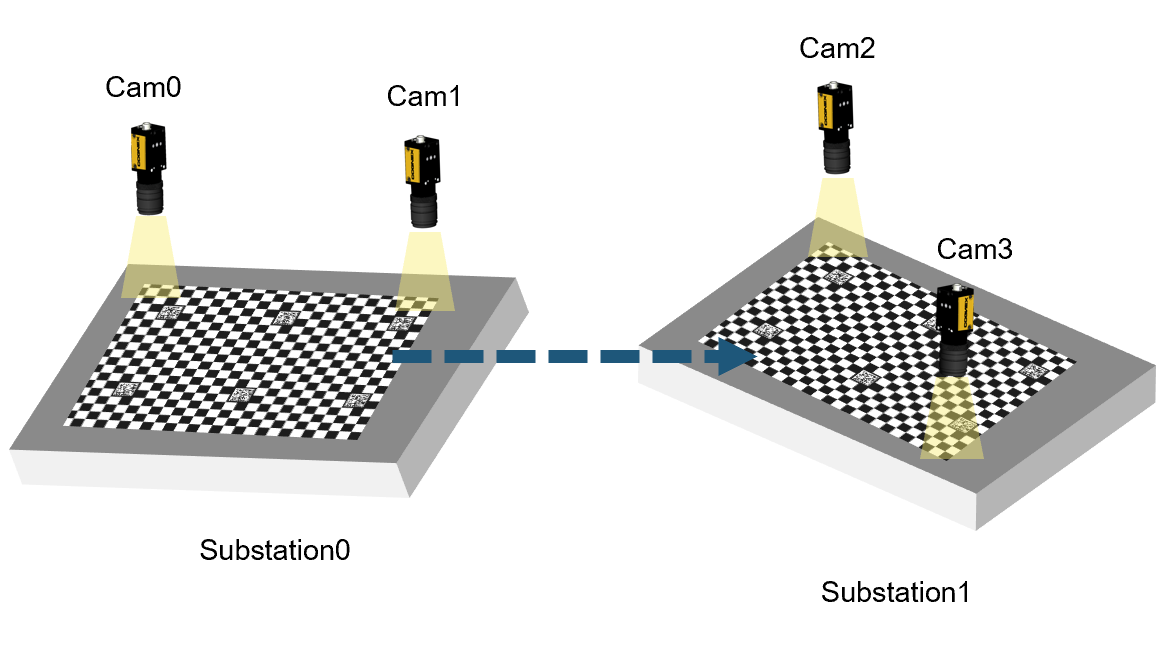
The advantage of using the checkerboard are:
- If care is taken to ensure that the image of the checkerboard spans the entire field of view of the camera, an accurate estimate of lens and perspective distortion can be obtained
- The user does not have to add any feature finders to extract features in the image. AlignPlus extracts the features from the calibration target
The disadvantages of using a checkerboard as a calibration target are as follows
- On some alignment systems, a special fixture may have to be designed to hold the calibration target. This is because the calibration target should be parallel to the plane of motion of the motion device
- The user would have to take care of the target and ensure that it is not damaged or lost
- Change to light settings, or additional lighting might be necessary to illuminate the calibration target
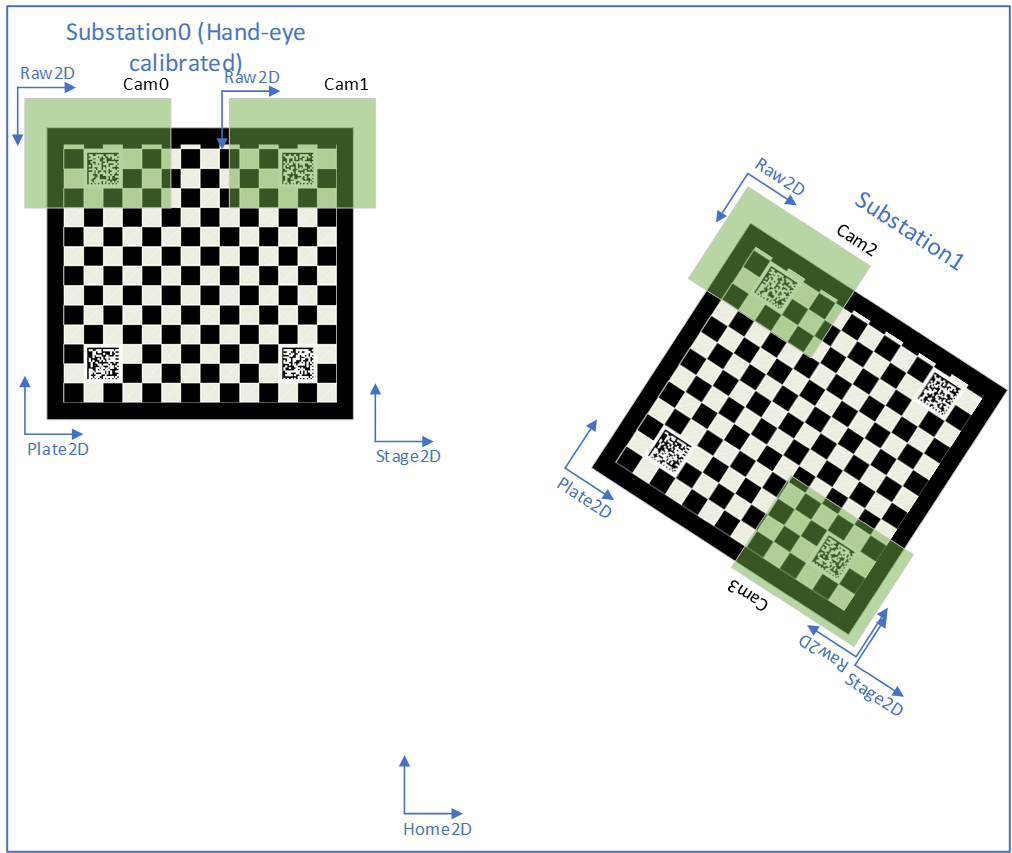
Cam2 and Cam3 are cross-station calibrated to SubStation0 using a checkerboard as a calibration target
Sequence of Commands
The following are the sequence of commands that must be sent from the PLC to AlignPlus to perform cross-station calibration for the above system
1. The gripper should present the checkerboard target to the substation that has been hand-eye calibrated, SubStation0 in the figure above, and should send the calibration command along with gripper pose at this station.
2. The gripper should present the checkerboard target to the substation that must be cross-calibrated, SubStation1 in the figure above, and should send the calibration command along with gripper pose at this station. Care should be taken to ensure that Plate2DFromStage2D is constant during the entire calibration process, which means that the relationship between the calibration target and the gripper should not change.